The new buzzword around town is “metaverse.” But what does that actually mean for businesses? Is it just something that social media companies need to be concerned about?
According to people like Apple’s CEO Tim Cook, the metaverse is coming. He stated that “Life without AR will soon be unthinkable.” Whether that’s a short-term or long-off prediction, companies need to be ready.
First comes the understanding of what the metaverse is. Metaverse is a general term – hence why it’s not capitalized like a proper name. The metaverse refers to a collective upgrade of the internet to a 3D virtual environment. This would be a world interconnected between various sites. These sites would reflect the immersive games that you see today.
Did Facebook/Meta invent the metaverse? No.
The idea of connected 3D immersive worlds has been around for decades. Several online gaming companies have staked a territory in the metaverse. But their applications are less interconnected.
What’s one of the best representations of the early metaverse? It’s a short-lived software called Adobe Atmosphere. This 3D immersive experience included interconnected online worlds. It also gave people the ability to chat with others. It was a bit before its time but shows how the concept of the metaverse has been around for a while.
The metaverse is getting attention now because technology has advanced. It has begun to catch up to the needs of such a world. This includes fast internet connections and immense processing power. It also includes a delivery method for 3D that works on most PCs.
Are we there yet? Not quite. But the metaverse is picking up steam. Recently, Microsoft announced a partnership with Meta. This partnership is to bring Microsoft 365 apps into the metaverse. This means collaboration in an entirely new way. Microsoft notes that 50% of Gen Z and millennials expect to do some of their work in the metaverse in the next two years.
With companies like Microsoft looking at the future of AR/VR, it could be a reality soon. You can expect the metaverse to touch your own company in some way in the next few years. Here’s a preview of what it may impact.
Where to Advertise
When the internet was first introduced, companies didn’t immediately realize its potential. Now, most companies wouldn’t consider operating without a website. It’s a necessity for driving leads and converting sales.
If the metaverse takes off as a new 3D iteration of the internet, it could be just as important. This means exploring metaverse-type advertising in virtual worlds. Also, potentially creating your own VR site or showroom.
How to Service Customers
As the popularity of social media took off, companies realized customers used it to reach out. Seventy-nine percent of consumers expect companies to respond to a social media message. And they expect that response within a day.
To address that need, many businesses have a social media presence. They use this for marketing and to answer questions and inquiries from customers.
The metaverse may be the next step. If people begin hanging out there, they will expect to interact with businesses in that space. Just like they do now with social networks.
This means companies need to be aware of how customers may be using the metaverse as it grows. Adding a question about metaverse use to a year-end customer survey could be a way to be proactive on this topic.
Employee Training
One of the touted benefits of the metaverse is its ability to enable more immersive training. This could greatly increase training capabilities for everyone from doctors to forklift operators.
Imagine being able to replicate a task more closely in a virtual world. A person could safely make mistakes there. Then they could grow proficient before doing that thing in real life.
Start thinking about the types of training that your employees need. Then, look at ways that a VR world may make the training safer or more efficient. The metaverse may not have what you’re looking for now. But with the pace of technological advancement, it could in a year or two.
More Immersive Remote Team Collaboration
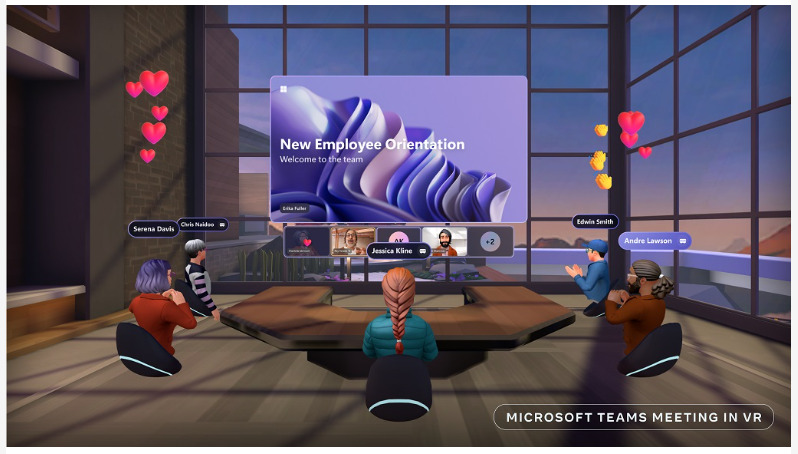
Virtual meetings skyrocketed out of necessity during the pandemic. Now, meeting by Teams or Zoom is commonplace. The next generation of online team meetings may end up being in a virtual world.
As we noted earlier, Microsoft is already working on bringing its apps into a virtual space. Add a few avatars and an immersive setting. Suddenly, you have a completely different meeting experience.
What’s one more way to enhance remote team collaboration in the metaverse? It has to do with building design and maintenance. Imagine being able to walk through a 3D recreation of a space before it’s built. Then fine-tuning the construction while inside that space.
Is Your Business Ready for the Next Digital Transformation?
What are your digital transformation plans for the next 12 months? The next three years? If you’re not sure where to begin, we can help. Contact us today to schedule a technology brainstorming session.
Scaling your business doesn’t just entail having suitable systems, staff, or partners. It also includes finding new and innovative ways to save time and money. And that’s where Virtual Reality (VR) technology comes in.
What is virtual reality, or VR?
VR is the technology that immerses you in a simulated digital environment. Wearing headsets and glasses, you enter the digital simulation and have a real-world experience.
When you think of VR, you might imagine a dark room full of gamers trying to outdo each other in their quest to rebel against alien empires. The truth is that the use of VR technology is currently experiencing an increase in growth not just in the gaming industry.
Several industry sectors have begun to realise that VR is an up-and-coming enterprise technology.
You can use VR to build a real-world to showcase products and turn ads into an engaging experience. And you can even use it to find and solve architecture and interior design issues.
Now, you may be thinking, “As a business owner, why should I care about virtual reality?”
The answer is simple:
Times are changing.
Whether you like it or not, it’s best to keep up to date with the evolving technologies, VR included. Moreover, if appropriately used, VR can take your business to the next level.
This article will share five ways that VR can save your business time and money.
The Five Ways VR Can Save You Time and Money
Way #1 – Create and Test Your Own Product Prototypes
If you’ve experienced developing your own product, you are fully aware by now of the time and costs required. From trail runs to reliability checks, you need to invest thousands of dollars and hours of your time.
With the help of VR technology, you can save time by prototyping and testing your product using an experimental model. Model creation in VR allows you to analyse your product in great detail at the preproduction and testing stages.
A significant advantage of virtual prototypes is that you can fix any problems in real-time. That means you won’t have to spend time and money to build a physical model.
Also, virtual prototyping allows you to see your product in various environments. Not to mention under different lighting and at different angles. Armed with that knowledge, you can make crucial decisions on colours or materials, among others.
Way #2. Showcase Your Products Worldwide
Imagine you are a manufacturer of tractors.
You’ve built a new line and want to show your fantastic new product at foreign expos abroad. Traditionally, you would need to pay exorbitant fees to transport your tractors so that you can exhibit them in those expos.
But why would you do that when you can use VR to create a realistic 3D model of the tractor at a fraction of the price?
The virtual 3D model will enable potential customers to see what the tractor looks like from all angles. They will also be able to see how it works in real-time.
Way #3. Use VR to Train and Educate Your Team
Suppose you’re thinking about training your team in soft skills. In that case, VR training could be a great alternative to using traditional screens and projectors.
Generally, using VR to train your employees can be done for much less than the cost of using conventional training methods.
Moreover, immersive VR training delivers intensive, more impactful learning experiences. VR training also removes the risk of unpleasant real-world consequences such as fallouts with team members.
Lastly, employees in VR training can be trained up to four times faster than e-learning and in-classroom trainees.
Let’s say you’d like to involve a bunch of specialists from around the world to help you develop a product.
While it would be fantastic to have them all brainstorm in one room, that would be an expensive plan. When you tally up the price of flight tickets, accommodation, taxis, and food, you’re looking at thousands and thousands of dollars to make it happen.
But thanks to VR technology, teams from different parts of the world can easily meet without breaking the back. All that’s needed is to buy VR headsets and join a collaboration network. In seconds, everyone can connect, collaborate, and share insights from the comfort of their workspace.
And since you are all working in the same environment and on the same model, the sharing of feedback happens in real-time and more effectively.
Way #5. Reduce Travel Expenses
Travel expenses can suck up a large part of company budgets. Fortunately, you can create virtual 3D models to show your product to potential customers. All without traveling to another state or country.
For example, a real estate agent might want to save time going from house to house with potential buyers. In that case, VR technology will enable the buyers to see what a property looks like in a virtual 3D setting. There’s no need for them (or the agent) to visit the property each time.
Similarly, anyone who needs to meet high-touch clients knows that being on the road is a huge time-waster. VR can replace your face-to-face interactions, saving you the trip there and back.
One of the best parts of VR communication is that your clients can stay up to date with what’s happening in a particular project. And that’s regardless of where they are located
VR to the rescue
VR technology is one of the most innovative ways to save your business time and money.
Initially, it may take time and resources for you to start using the technology. But in the long-term, VR will help you enhance and expand your business in new and exciting ways.
You can use VR in the initial stages of product design to avoid expensive mistakes or as a way to quickly and effectively train your team. VR is also a much cheaper option for you to showcase products aboard or collaborate with international colleagues.
Investing in VR is something that can greatly benefit any business.
Are you considering applying VR in your company?
Reach out to us for a quick 15-minute chat. Our tech experts will do their best to help you figure out how you can leverage VR technology in your business practices.
Burton Technologies Ltd is registered in England & Wales: Registered Number 13901816 VAT registration number 403763413 Mailing Address: 52 Chambers Avenue, Romsey. SO51 5BE